The Future Starts Earlier Than You Think
Electronics education usually starts too late and too abstractly. Children spend years hearing about electricity in science class before they ever touch a circuit — and by then, it’s already become “a hard subject.”
Play Trons starts at age 6. Not with theory. With a block in one hand and a block in the other, and the moment they click together and something lights up. That instant, satisfying result is where genuine curiosity about electronics begins.
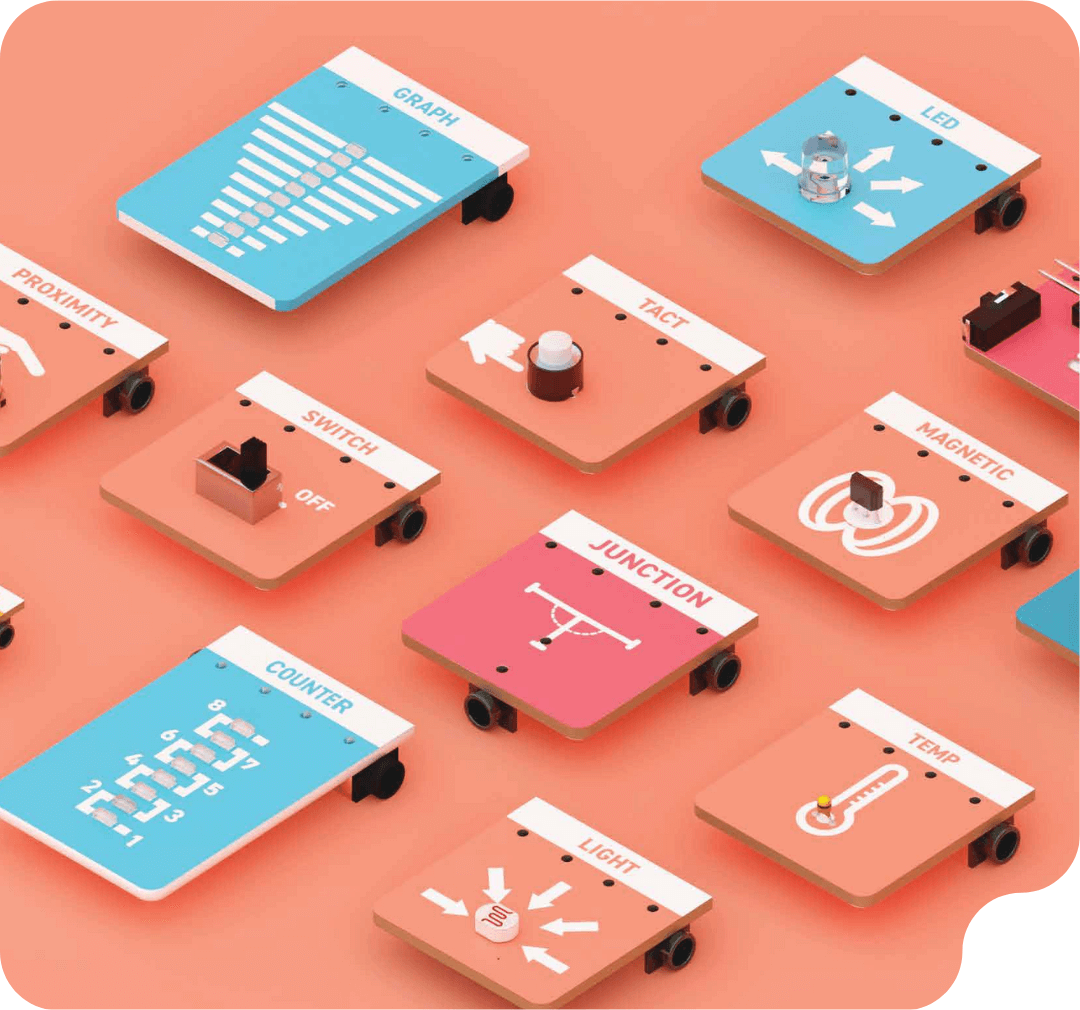
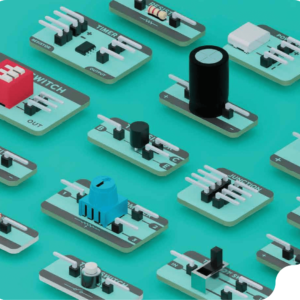
Every block is chunky, colour-coded, and clearly labelled. Connections are intuitive. Results are immediate. And because 16 structured guided classes are included, children don’t just play with the blocks — they learn what the blocks actually do, step by step, at a pace that builds confidence alongside knowledge.
What’s Inside the Play Trons Kit
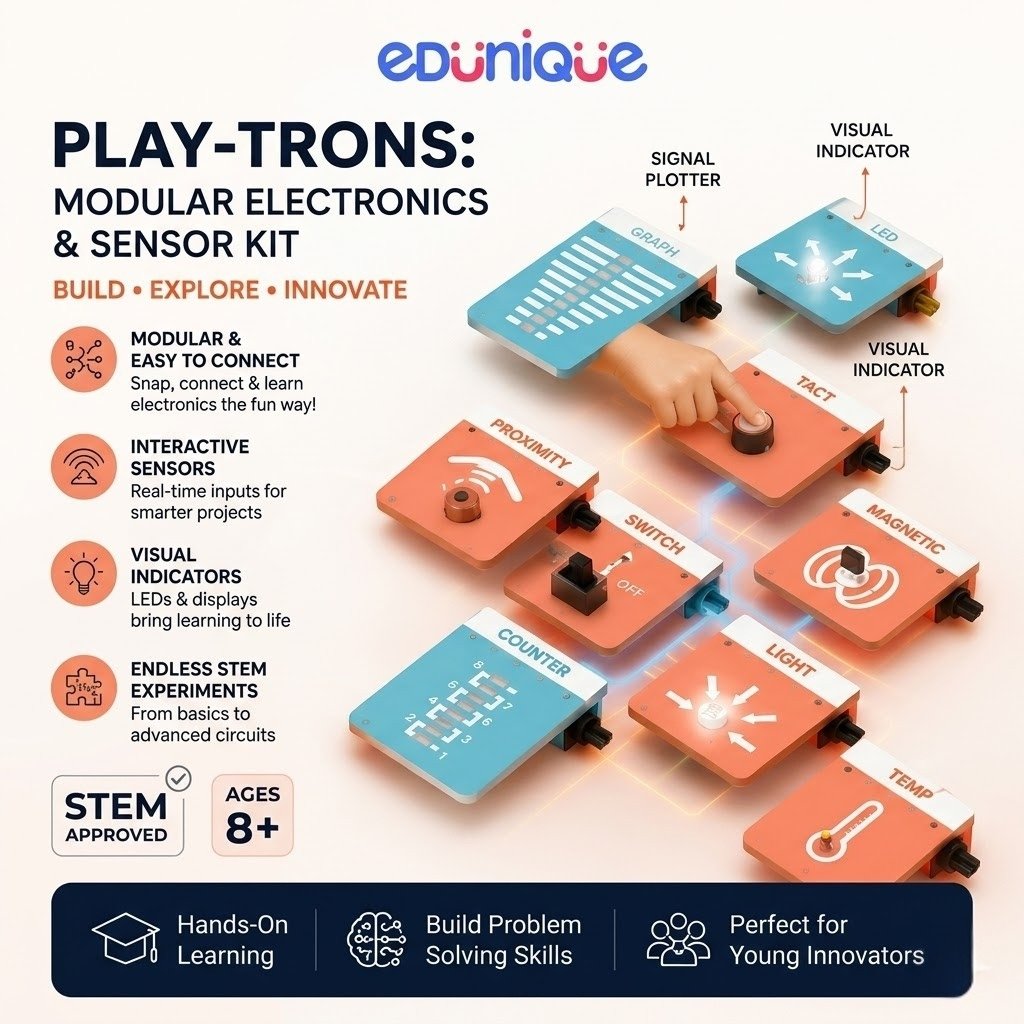
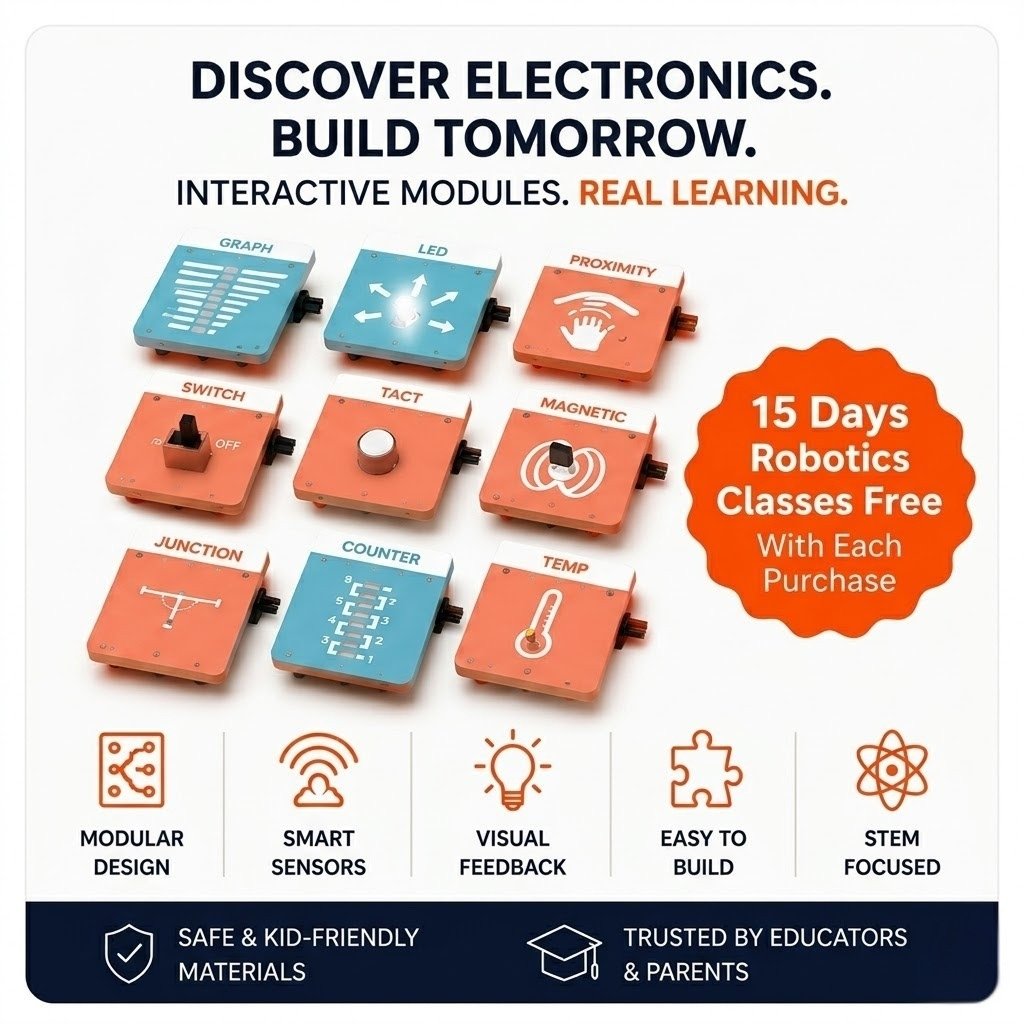
- Easy-to-handle electronic building blocks — chunky, child-safe components sized for small hands, including power, light, sound, and switch blocks
- Colour-coded and labelled — every block type is instantly identifiable
- No soldering, no tools — all connections are snap-fit, completely safe from age 6
- 16 guided class sessions — age-appropriate experiments introducing circuit basics through play
- Progressive difficulty — sessions grow in complexity matching the child’s developing understanding
Key Features at a Glance
- Easy snap-fit electronic building blocks — no tools or soldering required
- Chunky, colour-coded, and labelled design for young learners
- 16 structured guided class sessions included
- Child-safe ABS plastic and electronic components
- Block types: Power, LED, Switch, Sound, and Connector
- Progressive difficulty — from single circuits to multi-step builds
What Students Will Learn
- What a circuit is — and why it needs to be complete for electricity to flow
- Basic electronic components — batteries, switches, LEDs, and sound blocks
- Series and parallel connections — discovering what happens when connections change
- Cause and effect with electricity — turning things on and off, making lights bright and dim
- Problem-solving and patience — figuring out why something isn’t working
- Early STEM confidence — the self-assurance that comes from building something that works
Q1. Is 6 really old enough to start learning electronics?
Yes. Play Trons is specially designed to introduce electronics to children aged 6 and above through hands-on play.
Q2. Are the blocks completely safe for a 6-year-old?
Yes. The snap-fit blocks are child-friendly, easy to use, and require no tools or exposed wiring.
Q3. Will my child be able to do this without constant adult help?
Yes. The intuitive block design and guided lessons help children learn and build with confidence.
Q4. What’s the progression from Play Trons?
Children can progress to Play Tronix and later to the Pee Cee Compute Kit for advanced electronics and coding.
Q5. Can this be used in a classroom setting?
Yes. Play Trons is suitable for both individual learning and group classroom activities.